
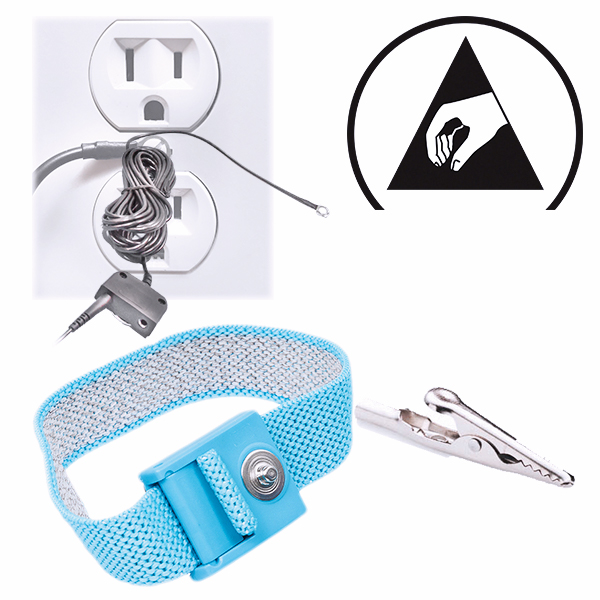
The short answer
Connect the cuff to a coil cord, then connect that cord to an electrical ground. Do not clip it to the mat.
Where to connect an anti-static wrist strap
Band the cuff to the skin
The inside of the strap is silver-suffused nylon or metal-banded so it captures charge from the skin at a conductive rate. It is worn on one hand, so the path is dedicated.
Snap on a coil cord with a resistor
A 4 mm stud snap on the outside of the strap takes the coil cord. The article says a typical cord is good for 50,000 flexes and includes a 1 megohm resistor that slows a discharge by a few more milliseconds.
Land the cord on an electrical ground
A common point ground can bond the mat and the wrist strap together. A continuous monitor can watch both. Grounding cables end in an eyelet that screws into an electrical outlet.
Use an alligator clip only on a known ground
Do not clip the wrist strap to the anti-static mat. The article says that raises total system resistance to ground over the 35 megohm limit in ANSI/ESD 20.20 and ESD Handbook TR20.20-2008 section 5.3.2.2.2.
Shop the wrist-strap path
There are actually multiple places where you can connect a wrist strap to in order to be grounded. Wrist Straps can be connected to an electrical ground line via an electrical outlet or clipped onto free-standing grounds (like a metal table on a stone floor).
ESD is based on the fact that people and things are made of electrons. When these electrons are scraped off us by contact with another object a destructive transfer of electrons (electrostatic discharge) potentially can take place.
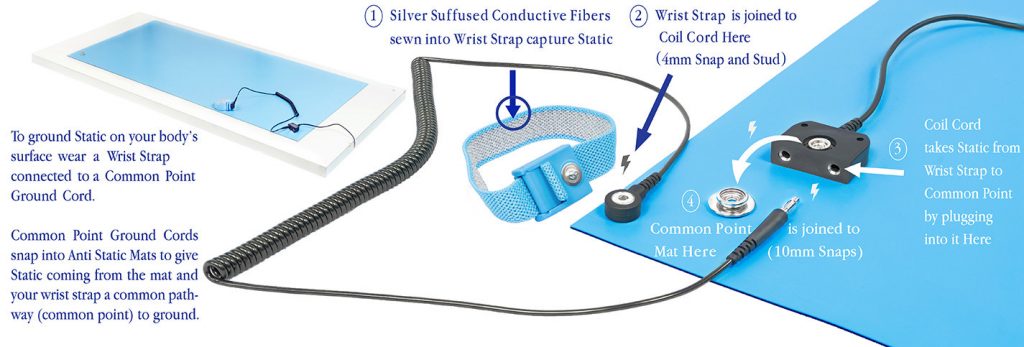
The wrist strap does two things to prevent ESD: it provides a conductive path to ground for electrons that are static on our skin and clothes, and since it is worn on one hand (instead of two) that path is “dedicated” making it easy for electricity on the surface of our skin to flow to that point.
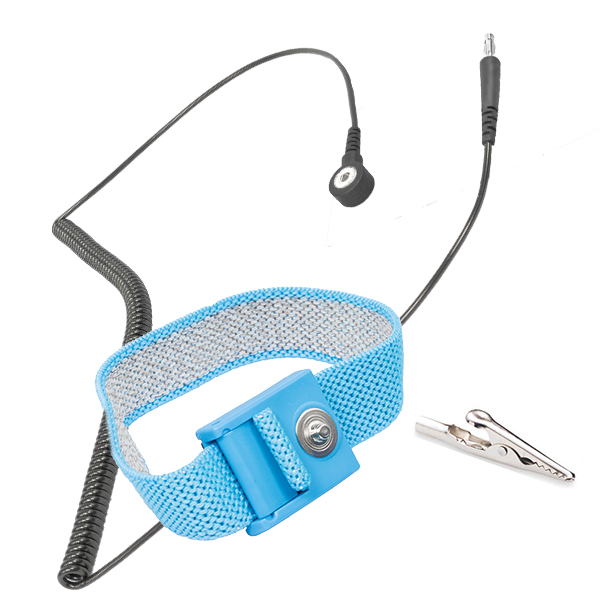
The inside of an anti static wrist strap is either silver-suffused nylon or metal-banded to capture static directly from your skin’s surface at a conductive rate.
A 4mm stud snap protrudes from the outside surface of the strap where you will connect to a coil cord (typically good for 50,000 flexes) that has a 1 megohm resistor built into it.
The resistor slows down an electrostatic discharge event (ESD) from a highly charged ungrounded surface from discharging instantaneously through the coil cord a few more milliseconds than if it were not present.
Next, we want to connect the coil cord to an electrical ground so that we are not electrically isolated, but instead electrically bonded- grounded.
A common point ground can be used to ground both an anti static mat and the wrist strap together. You could also choose to use a continuous monitor to make sure both the wrist strap and your anti static mat are grounded.
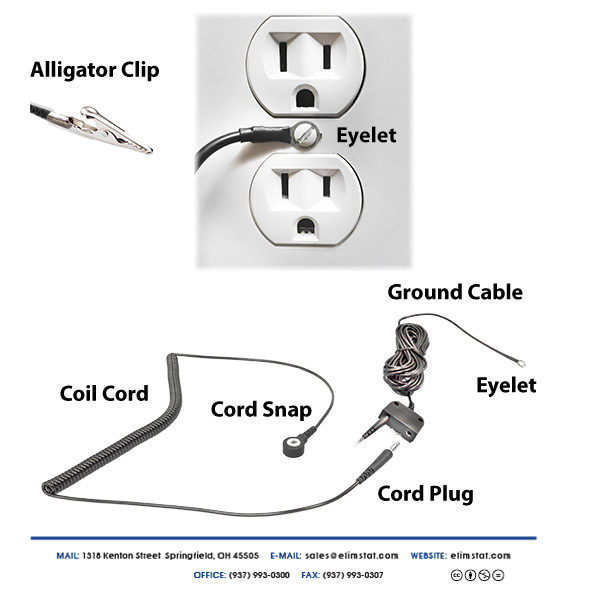
Grounding cables end in an “eyelet”. This eyelet is a metal ring that you can screw into an electrical outlet to transfer static from you to the ground line in your building.
Alternatively you can fix an alligator clip on the end of your cable to a conductive surface that leads to ground.
Just make sure you do not use the alligator clip to “ground” the wrist strap to an anti static mat. This will not work. In fact, this will increase the total system resistance to ground over the 35 megohm limit recommended per ANSI /ESD 20.20 [ESD Handbook Tr20.20-2008 section 5.3.2.2.2]
Unless you have to, it’s recommended not to use the alligator clip. While it seems convenient, it is best used only when you are sure of the pathway to ground you are attaching it to.
Questions this guide answers
What does the wrist strap do?
It gives electrons that are static on skin and clothes a conductive path to ground. Worn on one hand, that path is dedicated.
Why is there a 1 megohm resistor in the cord?
It slows an electrostatic discharge from a highly charged ungrounded surface so the event does not pass through the coil cord all at once. The article says the delay is a few more milliseconds.
Where can the cord be connected?
To an electrical outlet through an eyelet, or with an alligator clip to a conductive surface that leads to ground, such as a metal table on a stone floor. A common point ground can share that connection with a mat.
Why not clip the strap to the mat?
The article says it will not ground the strap and will push total system resistance over the 35 megohm limit cited from ANSI/ESD 20.20 and ESD Handbook TR20.20-2008 section 5.3.2.2.2.