
The short answer
Start from ANSI/ESD S20.20, then use the worksurface, grounding, garment, and personnel tests the article names.
TR53 personnel limits in this article
- Under 3.5 × 10^7 ohmsWrist-strap systemTR53 limit cited for the wrist strap.
- Under 1 × 10^9 ohmsFoot grounderTR53 limit cited for the foot grounder.
- S4.1Worksurface matResistance top-to-top and resistance-to-groundable point, with an ESD meter kit.
How to check ESD resistance for mats, garments, and people
Test the mat top
ANSI/ESD S4.1 calls for resistance top-to-top and resistance-to-groundable point on the work surface. Both tests can be done with an ESD meter kit. Section 8.0 describes a resistance range that has generally protected manufacturing environments.
Bond the workstation to the outlet
The article names ANSI/ESD 6.1 for how wrist straps, personnel, and mats are bonded. Connect grounded people and equipment to an electrical outlet. Cables end in eyelets so they can tie into that outlet.
Test the smock panels
S20.20 defines a static control garment, a groundable static control garment, and a groundable static control garment system. TR53 garment tests support the compliance-verification plan. Place the garment on an insulative surface with sleeve inserts, measure sleeve to sleeve with 5 pound electrodes, apply 10 volts and read after 5 seconds, and if the reading is at least 1.0 × 10^6 ohms apply 100 volts for at least 15 seconds.
Test wrist straps and foot grounders at the entrance
TR53 looks for a wrist-strap system under 3.5 × 10^7 ohms and a foot grounder under 1 × 10^9 ohms. A combo tester at the entrance to the ESD area is the usual setup. Both are flexed in use, so test them regularly.
Shop what these checks cover
1. ESD Mat Requirements
Since static exists on the surface of an object, what we want to test anti static mats for is their ability to dissipate static on their top surface or work surface. Hence the title ANSI / ESD S4.1 Worksurfaces – Resistance Measurements. The standard recommends us to perform two types of tests on the top surface of a mat used for static control: a resistance top-to-top (RTT) test, and a resistance-to-groundable point (RTG) test. You can perform both tests with an ESD meter kit.
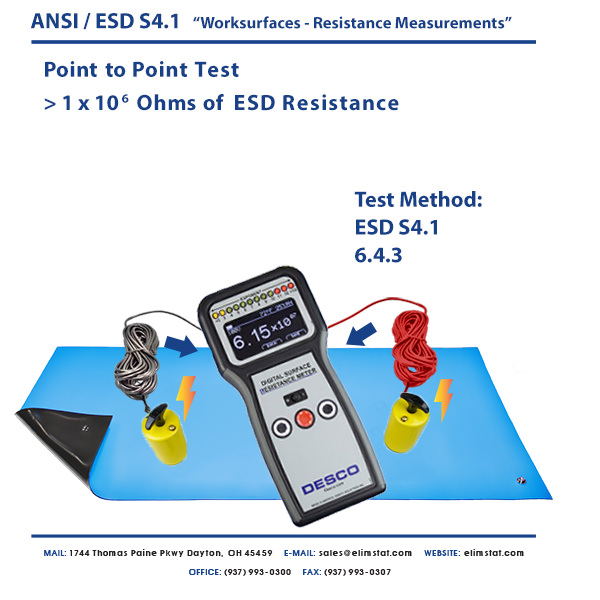
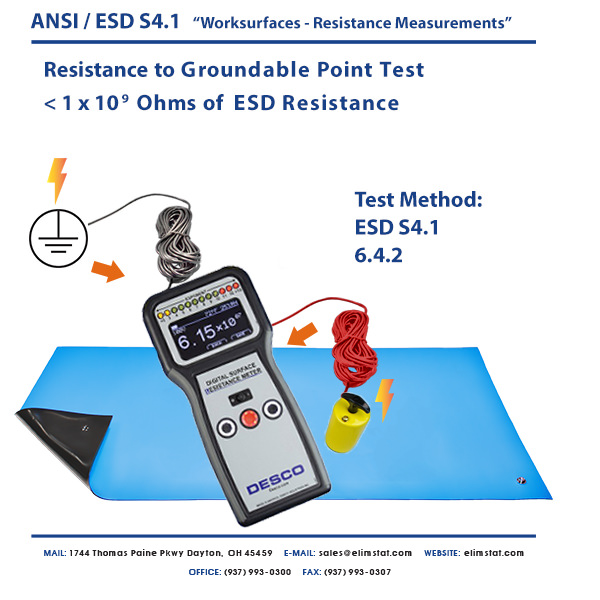
As they state in section 8.0, “these guidelines represent a range of resistance that has generally been proven to provide protection in the manufacturing environment.”
2. ESD Workstation Grounding Requirements
The single most important concept in the field of static control is grounding. Attaching all electrically conductive and dissipative items in the workplace to ground allows built-up electrostatic charges to equalize with ground potential. A grounded conductor cannot hold a static charge.
“ANSI / ESD 6.1 ESD Association Standard for the Protection of Electrostatic Discharge Susceptible Items – Grounding

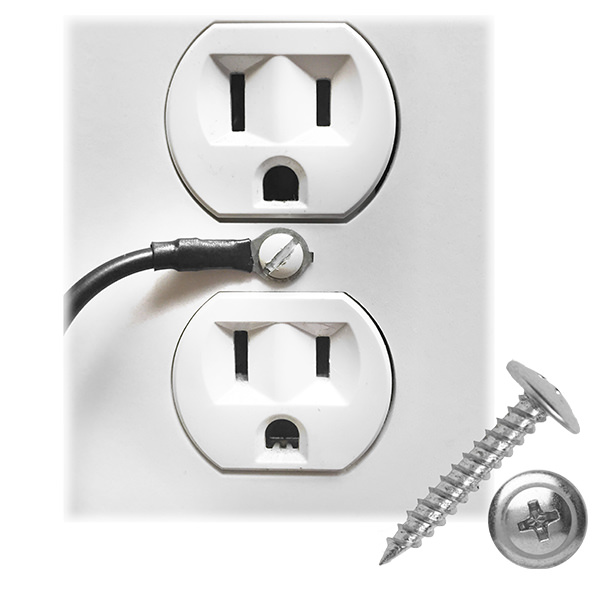
The standard governing workstations is ANSI / ESD 6.1
It covers the range of ways that wrist straps, personnel, and mats can be electrically bonded (grounded).
You should connect all grounded people and equipment to an electrical outlet. Electrical outlets follow the piping to the Earth underneath building.
Grounding Cables end in eyelets so that you can tie them into the outlet. When you are wearing a wrist strap or standing on a mat, the force of gravity draws electrons from your body and mats through the grounding cables into the outlet.
The electrical field underneath the building is now in balance with you.
3. ESD Smock Test Methods and Definitions
Garments used for ESD Safety are defined in ANSI / ESD S20.20 2014 as either a “Static Control Garment”, a “Groundable Static Control Garment”, or a “Groundable Static Control Garment System”.
ESD TR-53 specifies in the Garments section testing that is used for the Compliance Verification Plan Requirements of ANSI/ESD S20.20.
Since ESD clothing is made with carbon woven into it so that it is “static shielding” the primary test of whether or not it qualifies as a “static control garment” revolves around sleeve panel to sleeve panel conductivity.
An ESD meter kit is used to perform resistance top-to-top (RTT), and point-to-groundable point (RTG) tests across the panels of an ESD garment.
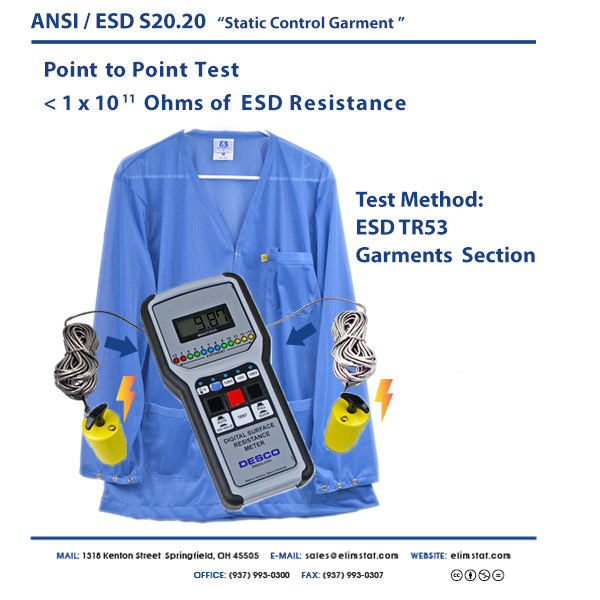

• Place the garment on an insulative support surface with the inside surfaces laying on the specimen support surface (with the front panels opened and laid out as flat as possible; larger garments such as coveralls may not allow this completely).
• Position insulative sleeve inserts into each sleeve (including legs of a coverall) of the garment under test to isolate one side of the fabric from the other.
• Attach cables to the two 5 pound electrodes and place one electrode on one of the garment sleeves directly above the insulative sleeve insert. Place the second electrode on another part of the same sleeve. Apply 10 volts and observe the reading after 5 seconds. If the reading is less than 1.0 x 10⁶ ohms, record the value. If the reading is greater than or equal to 1.0 x 10⁶ ohms, apply 100 volts for a minimum of 15 seconds (or until the reading stabilizes) and record the results.
• Repeat the test for the remaining garment panels as well as the second garment sleeve by moving the second electrode. When measuring the garment sleeves ensure that the electrodes are directly above the insulative sleeve inserts.
4. How to Check ESD Grounding of Wrist Straps and Foot Grounders
ESD TR53‘s Wrist Strap and Footwear sections also specify testing that is used for the Compliance Verification Plan Requirements of ANSI/ESD S20.20. for using heel grounders and wrist straps.
To test you would typically use a combo tester at the entrance to ESD safe work areas.
The testing, therefore, looks for a reading from the wrist strap system of less than 3.5 x 10⁷ (35,000,000) ohms, and a reading from the foot grounder of less than 1 x 10⁹ ohms (1 gigohm).
Since wrist straps and foot grounders are regularly flexed testing their electrical resistance regularly is encouraged.
Questions this guide answers
Where does an ESD program start?
The article says ANSI/ESD S20.20 is the document to start with, and that implementing it means using the additional standards for workstations and personnel.
What two tests does S4.1 recommend on a mat?
Resistance top-to-top (RTT) and resistance-to-groundable point (RTG), both with an ESD meter kit.
What is the workstation grounding standard in this article?
ANSI/ESD 6.1. It covers how wrist straps, personnel, and mats are electrically bonded. The article says outlets follow the building piping to earth.
What personnel limits does TR53 use here?
Less than 3.5 × 10^7 ohms for the wrist-strap system, and less than 1 × 10^9 ohms for the foot grounder.