
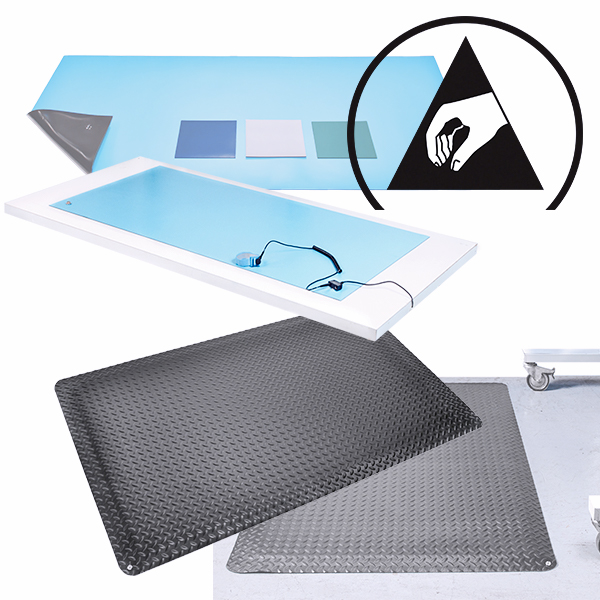
The short answer
A dissipative worksurface mat uses a conductive bottom and a snap. A conductive floor mat is for what the operator stands on.
Conductive, dissipative, insulative
- Below 1 megohmConductiveThe article places the line between conductive and static dissipative at 1 megohm.
- 1 megohm to 1 gigaohmStatic dissipativeThe worksurface range between those two lines.
- Above 1 gigaohmInsulativeThe article places the line between static dissipative and insulative at 1 gigaohm.
How an ESD mat moves charge to ground
Match the mat to the surface
S4.1 applies to what the product rests on: benches, carts, shelves, tables, trays, and workbenches. S7.1 applies to what the operator stands on. A footwear and floor system is also checked with the system test and verified per TR53.
Use a two-layer mat on the bench
Table mats are typically two-layer rubber. The dissipative top captures charge from tools and electronics. A snap connects through to the conductive bottom, and the common point ground connects to that snap.
Ground each mat to the outlet
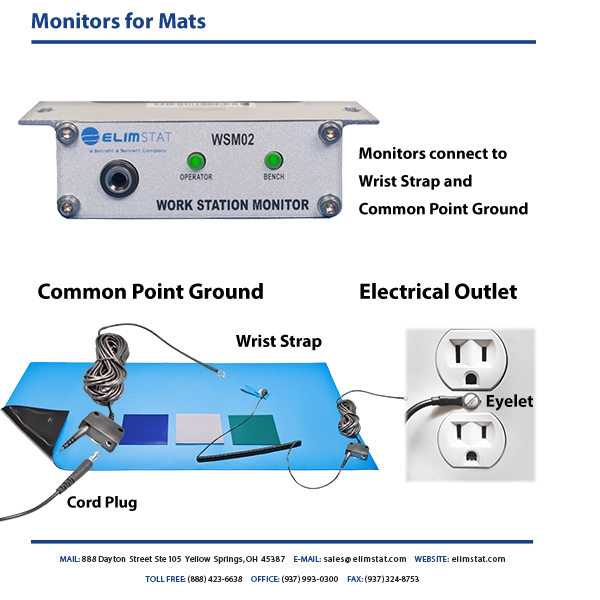
Do not daisy-chain mats. Grounding wires contain 1 megohm resistors, so chaining them increases resistance. Connect mats directly to the electrical outlet. Several mats may share one outlet.
Use a conductive mat on the floor
Floor mats are black because they are carbon-infused. Charge can travel into a conductive floor or to an outlet through a mat ground. Heel grounders use the same carbon-loaded rubber, with a silver ribbon in the sock.
Shop mats and grounds
Sometimes there’s confusion about how ESD mats work and where they should be used. In professional ESD control programs, mats are selected and evaluated for their intended application in accordance with ESD Association standards.
For worksurfaces (benches, carts, shelves), use ANSI/ESD S4.1 criteria and test methods (e.g., resistance to groundable point and point-to-point). For floors/floor mats, use ANSI/ESD S7.1 for flooring material performance—and when the mat is part of a footwear/floor grounding system, evaluate it using the footwear + floor system test methods (and verify in the program per TR53).
The Static Dissipative Range
All anti static esd mats have conductivity, but are either static dissipative or conductive.
Static electrons can accumulate on the surfaces of insulating materials, such as tables and floors, so we use ESD mats to cover these surfaces. The mats’ conductivity prevents charge from becoming trapped.
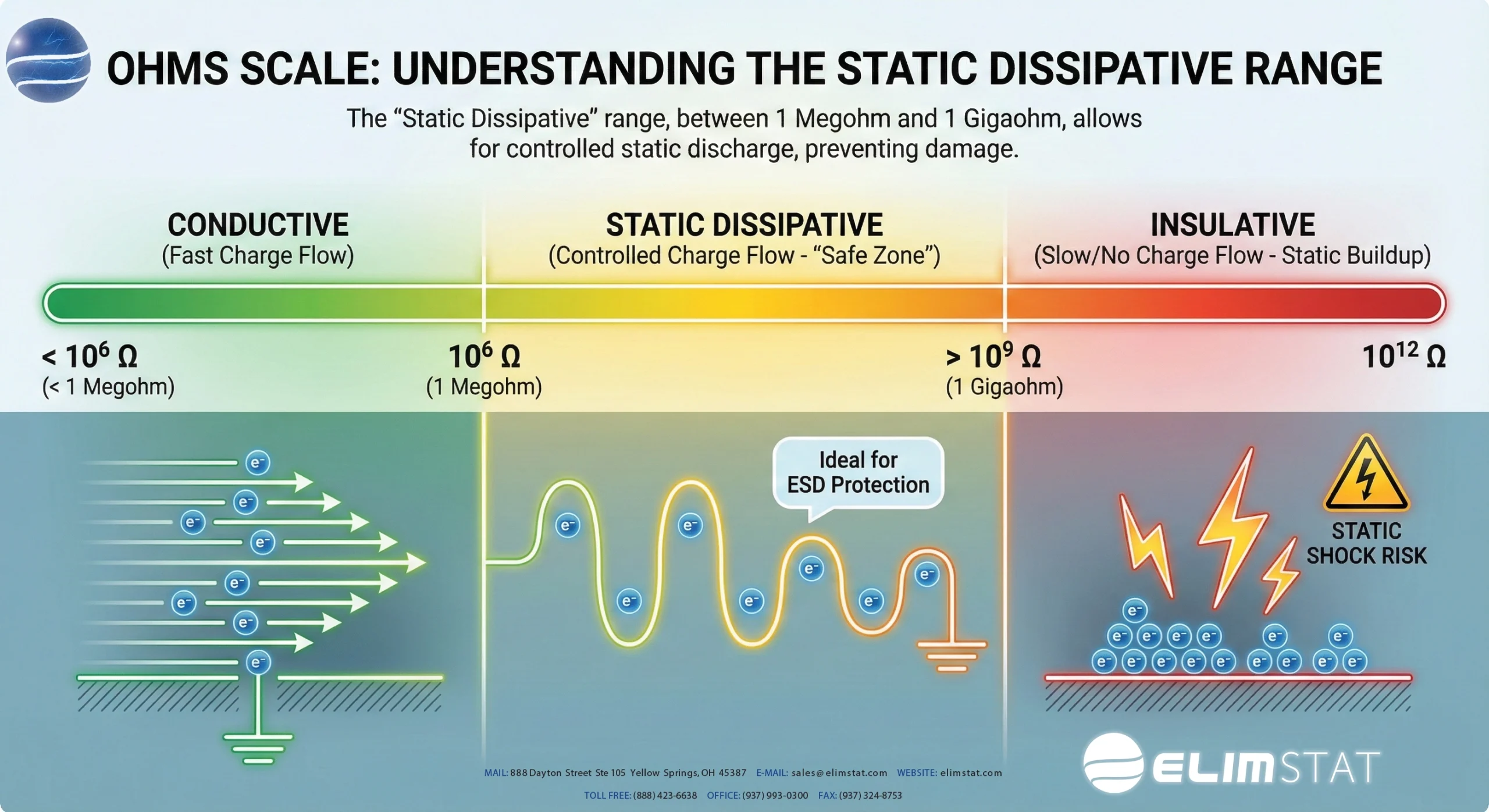
The boundary between conductive and static dissipative is 1 Megohm.
The boundary between what is considered static dissipative and insulative is 1 Gigaohm.
The ANSI / ESD standard for the measurement of table worksurfaces is ANSI / ESD S4.1 Worksurfaces- Resistance Measurements. It notes that the layout and requirements of different workplaces may require different tailoring, but recommends this static dissipative range for worksurfaces.
ESD Static Dissipative Mats
ESD Static Dissipative Mats used on top of tables or workstations are typically two-layer rubber mats. (This is sometimes also called a “dissipative mat”). The top is static dissipative, and the bottom is conductive.
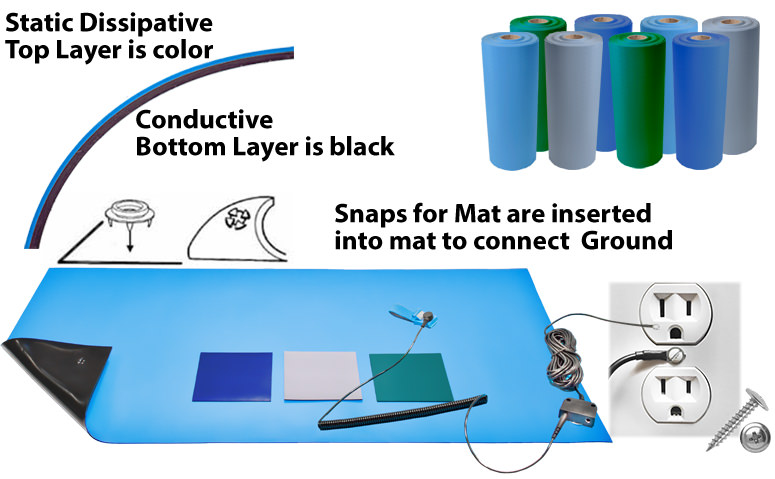
The top layer captures static from tools and electronics. A snap connects through to the bottom conductive layer, creating a path to ground. This snap is what the common point ground is connected to.
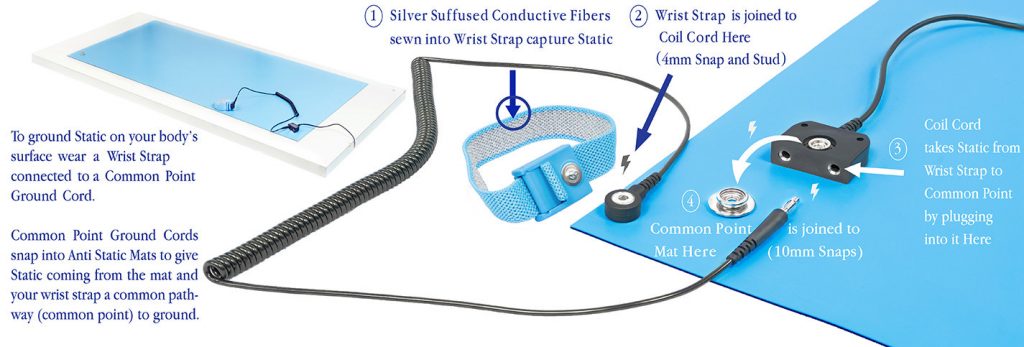
Mats should not be grounded in series, i.e., “daisy-chained” together. Since the grounding wires contain 1 Megohm resistors, daisy-chaining mats increases resistance.
Instead, directly connect them to the electrical outlet. Multiple mats can be connected to the same outlet.
Since S4.1 is concerned with ensuring that mats are static dissipative, you should test them periodically after purchase according to your program needs.
However, consider using a Continuous Monitor with esd workbench mats. Monitoring ensures this ground connection is maintained in real time. For high-reliability programs focused on zero defects, continuous monitoring is preferable to only testing.
ESD Floor Mats and Heel Grounders
Conductive mats are typically used as ESD Floor Mats. They are black because they are carbon-infused, and to indicate to end users that they are conductive.
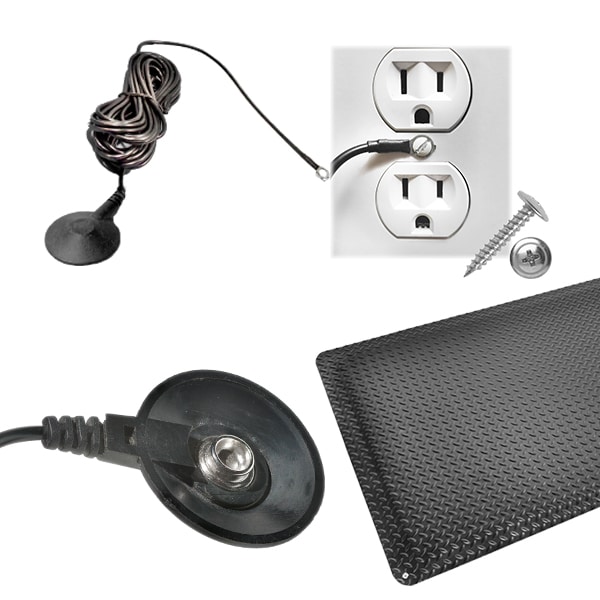
Static can travel from these floor mats to conductive floors or to an electrical outlet via a mat ground.
Carbon-infused rubber is also used in heel grounders, which is why their bottoms are black.
A silver ribbon inside your sock keeps the heel grounder connected to your body. This gives static on the body’s surface a dedicated ground path through the heel grounder into the mat.

In an EPA (Electrostatic Discharge Protected Area), tables and floors must connect to a common ground. Nothing should be electrically isolated—everything needs a path to drain static.
Questions this guide answers
Where is the line between conductive and dissipative?
The article places the boundary between conductive and static dissipative at 1 megohm, and the boundary between static dissipative and insulative at 1 gigaohm.
Why are worksurface mats two layers?
The dissipative top captures charge from tools and electronics. The snap reaches the conductive bottom so the common point ground has a path off the mat.
Why not daisy-chain mats?
The grounding wires contain 1 megohm resistors. Connecting mats in series increases resistance. Connect each mat to the outlet.
What is a conductive floor mat for?
Conductive mats are typically floor mats. They are black because they are carbon-infused. In an EPA, tables and floors must share a common ground so nothing is electrically isolated.