
The short answer
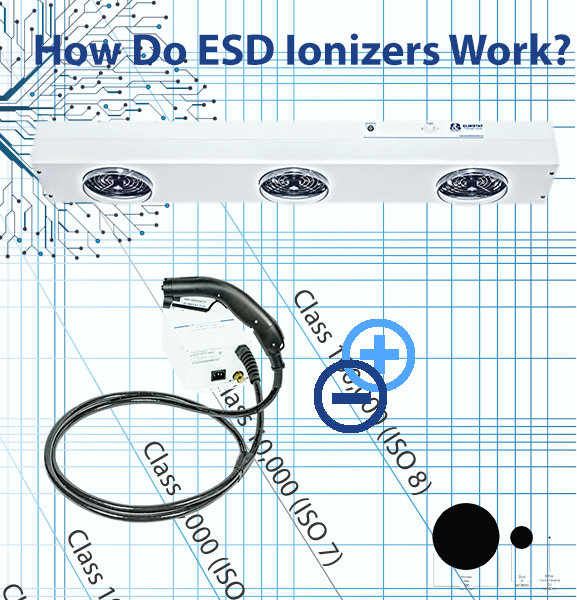
An ESD air ionizer cleans the air of static charge and particulate matter. Voltage on a metal emitter needle creates a corona that interacts with electrons in nearby gas molecules, and a motor pushes that ionized air at the surface so it attracts or pushes particles and static off the object.
Where an ionizer is used
- TabletopOn the benchUsed on table tops.
- Machine or overheadAround the lineUsed inside machines and from overhead.
- Blow-off gunIn the handA gun uses a single emitter point and is held close to one spot.
How the ionizer works
Apply voltage to the emitter point
An emitter point is a metal needle that conducts charge. Guns use one point. Blowers use several. Voltage from the power source creates an electric field, a corona, around the emitter.
Let the corona interact with the gas
The corona interacts with electrons in nearby gas molecules. Alternating current (AC) or direct current (DC) produces the ions.
Push the ionized air at the target
The motor pushes the ionized air toward the surface you aim it at. Some DC ionizers used in cleanrooms do not use airflow at all.
Clear static and particles from the object
Ionized air attracts or pushes particles and static off the object. That addresses electrostatic discharge (ESD) and electrostatic attraction (ESA).
AC and DC
AC ionizers
Normally preferred on automated assembly lines, where charge needs to leave evenly and quickly. Overhead and all-purpose blowers, and blow-off guns used close to the target, typically use AC.
DC on a moving line
Emitter points are spaced apart and shoot ions in sequence, unlike AC ionizers running at line frequency. One side of an object can lose its charge while the other side is left untouched.
DC over distance
DC ionizers shoot positive and negative ions from separate points at constant rates. Less recombination over distance can leave charge accumulated in the air. Some are used in cleanrooms with no airflow.
Consult an ionization professional before installing DC ionization.
Shop ionization
We often hear our customers say they want to “de-ionize” or “ionize” air flow to protect ungrounded electronics and work surfaces from holding a static charge.
Air Ionizers are used to clean air of static charge and particulate matter.
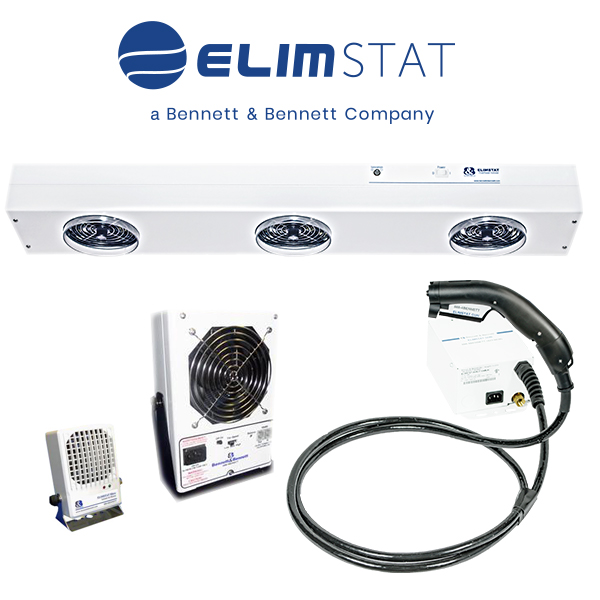
They are used on table tops, inside machines, from overhead, and as guns that are handheld.
When ionized air comes into contact with particulate matter it attracts or pushes particles and static off of the object you are trying to protect from electrostatic discharge (ESD) or cross contamination from electrostatic attraction (ESA).
1. How does air become ionized?
Ionizers are made up of either a single emitter point (guns) or multiple emitter points (blowers). An emitter point is a metal needle that conducts charge.
When the voltage from an electrical power source is applied to an ionizer’s emitter point, it creates an electric field or “corona” around the emitter.
This corona of ions then interacts with electrons in nearby gas molecules. With the use of alternating current (AC) or direct current (DC) the ionized air is pushed by the motor in the ionizer towards the surface you are aiming it at.
2. AC vs. DC ESD Air Ionizers
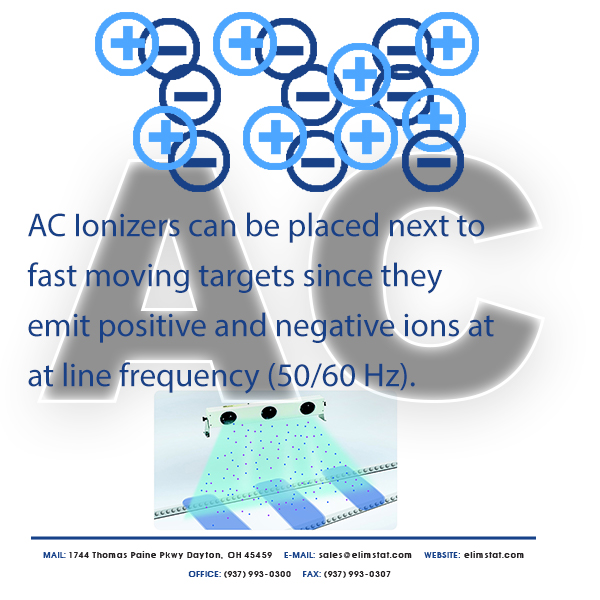
When choosing an ionizer you will want to consider how quickly you need it to work, and how close you can place it to the target.
AC Ionizers are normally preferred in automated assembly-line applications where you need to ensure charge is dissipated evenly across the surface of an object quickly.
Overhead and all-purpose blowers typically use AC ionization because they can be close to moving targets on assembly lines or overhead a workstation. Blow-Off Guns that are used to pinpoint ionization at specific spots typically also use AC ionization because of how close the operator can be to the target.
If you were to use DC ionization on an automated assembly line, “streaking” could occur: one side of an object can be reduced of its charge, and the other side of the object can be left untouched.
This is because DC ionizers have emitter points spaced apart, and are forced to shoot ions in sequence to achieve the same effect as AC ionizers running at line frequency.
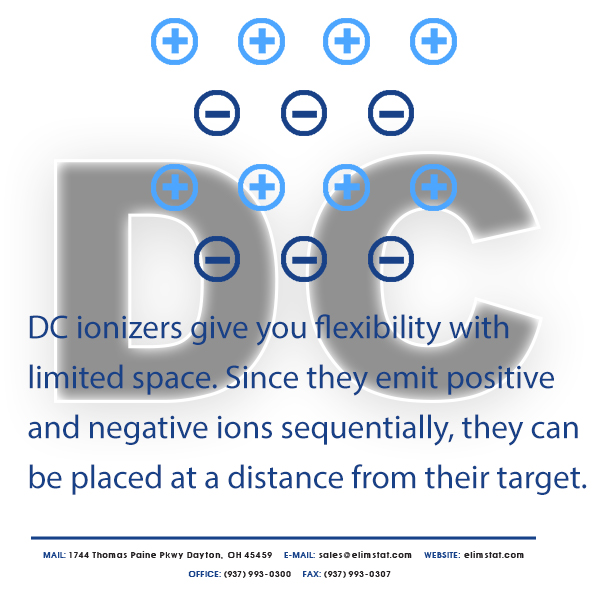
Direct current (DC) ionizers shoot both positive and negative ions through their emitter points at constant rates.
Since the ions are emitted from separate points, there is much less recombination of ions over distance– which can cause charge to accumulate in the air.
In fact, some DC ionizers are used in clean rooms without using air flow at all.
Typically it is best to consult with an ionization professional before installing DC ionization to make sure you are able to achieve your goals with the pulsing of positive and negative charges.
3. When Should I Use Ionization?
If you cannot uninstall features of your work area that are insulative the only alternative is to use ionization. Static electricity causes primarily two problems: electrostatic discharge (ESD) which permanently damages electrical circuits and electrostatic attraction (ESA) which can contaminate a controlled environment or clean room.
Electrostatic Discharge (ESD)
Most computer parts are sensitive to ESD, but some parts are more sensitive than others. The most sensitive parts are those that contain transistors or integrated circuits (ICs). These parts can be damaged or destroyed by ESD, even if you don’t feel a shock.
Here are some of the most common computer parts that are sensitive to ESD:
- Processor
- Memory
- Graphics card
- Hard drive
- Motherboard
- Power supply
ESD can also cause physical damage people can feel. For example, ionization is often used in the manufacture of plastics to dissipate the ambient charge generated in low humidity by plastic film rolling over metal production lines. The amount of charge that can build up in these situations can literally cause people to feel themselves being zapped if they are near enough the static electricity.
Electrostatic Attraction (ESA)
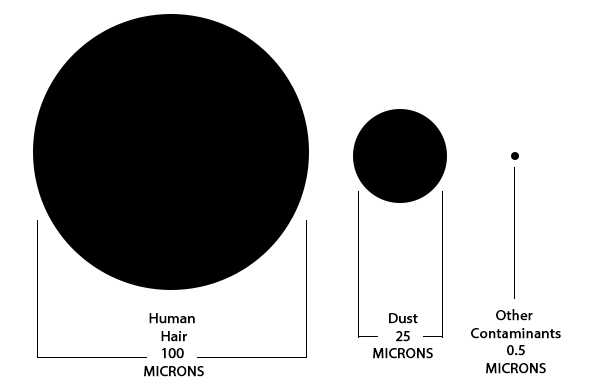
The second problem caused by static is that a charged object can attract particulate matter onto it. Known as ESA, electrostatic attraction can cause the charged object to become contaminated and no longer usable.
In fact, ionization is increasingly being used inside clean rooms as more engineers realize that air filtration alone does not ensure the elimination of particulate contamination from subvisible particles (less than 25 microns).
Ionization is increasingly being used in the manufacture of medical devices to combat ESA contamination as more manufacturing moves to clean room environments.
Questions this guide answers
What does an ESD air ionizer do?
Air ionizers clean the air of static charge and particulate matter. When ionized air meets particles, it attracts or pushes particles and static off the object you are protecting from electrostatic discharge (ESD) or from electrostatic attraction (ESA).
How does air become ionized?
An emitter point is a metal needle that conducts charge. Voltage applied to it creates a corona. The corona interacts with electrons in nearby gas molecules. With AC or DC, the motor pushes that ionized air toward the surface.
Where are air ionizers used?
On tabletops, inside machines, from overhead, and as handheld guns. Guns use a single emitter point. Blowers use multiple emitter points.
When is AC ionization preferred?
AC ionizers are normally preferred in automated assembly-line applications where charge must dissipate evenly and quickly. Overhead and all-purpose blowers, and blow-off guns used close to the target, typically use AC.
What is streaking with a DC ionizer?
On an automated assembly line, one side of an object can be reduced of its charge while the other side is left untouched. DC emitter points are spaced apart and shoot ions in sequence, unlike AC ionizers running at line frequency.
Do DC ionizers always need airflow?
No. Some DC ionizers are used in cleanrooms without airflow. DC ionizers shoot positive and negative ions from separate points at constant rates, so there is much less recombination over distance, which can cause charge to accumulate in the air. Consult an ionization professional before installing DC ionization.
When is ionization the only alternative?
When you cannot remove insulative features of the work area. Static causes electrostatic discharge, which can permanently damage electrical circuits, and electrostatic attraction, which can contaminate a cleanroom. Air filtration alone does not eliminate subvisible particles smaller than 25 microns.
Which computer parts does the article call out as ESD-sensitive?
Parts that contain transistors or integrated circuits can be damaged even if you do not feel a shock. The article lists the processor, memory, graphics card, hard drive, motherboard, and power supply.