
The short answer
Bond the work surface with a dissipative mat and bond the person with a wrist strap to the same ground. Do not clip the strap to the mat.
Where S4.1 puts the mat
- Under 1 × 10^6 ohmsConductiveBelow the static-dissipative range.
- 1 × 10^6 to 1 × 10^9 ohmsStatic dissipativeThe range S4.1 recommends for shelves, tables, trays, and workbenches.
- Above 1 × 10^9 ohmsInsulativeHolds charge. Not a worksurface mat.
How to set up an ESD mat and wrist strap
Cover the work surface with a dissipative mat
ANSI/ESD S4.1 recommends static-dissipative mats for shelves, tables, trays, and workbenches. Less than 1 × 10^6 ohms is conductive, above 1 × 10^9 ohms is insulative, and the range between them is static dissipative. Most of these mats are dissipative on the blue top and conductive on the black bottom.
Ground the mat at the outlet
The grounding cable connects the worksurface mat to the grounded electrical outlet. There are separate cables for mats, wrist straps, and a common point ground for both.
Do not clip the wrist strap to the mat
An alligator clip from the wrist strap to the mat increases total system resistance because both cords already include resistors. Use the clip only when the path to ground is known.
Wear the wrist strap to the common ground
The strap keeps the wearer at the same potential as the mat. S20.20 section 8.2 recommends a wrist strap at all times when personnel are seated. When standing, use a wrist strap and/or a footwear and flooring system.
Shop the workstation
In ANSI/ESD S20.20 Section 8.2 (Personnel Grounding), recommended requirements are outlined for how personnel should be electrically connected to a grounding system with a wrist strap. S20.20 also includes recommendations for “ESD Control items” (i.e., esd mats and wrist straps) in Section 8.3 ESD Protected Areas (EPAs).
ESD Mats for Tables
ESD mats that are compliant with S20.20 are defined in Table 3 of Section 8.3 ESD Protected Areas (EPAs). This table in turn references the Product Qualification (STM 4.1) and Compliance Verification (TR53) standards for on-site use.
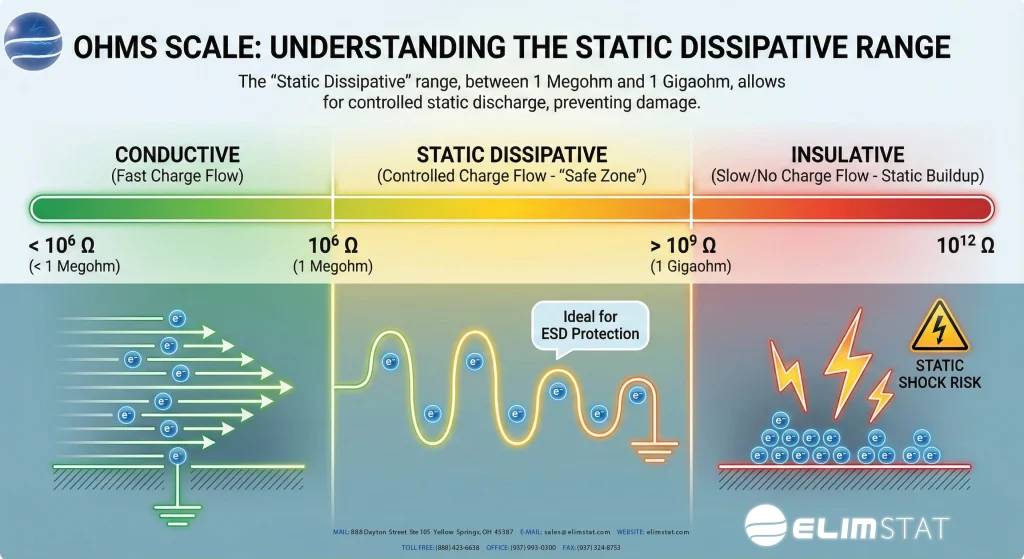
• Anything less than 1 x 10⁶ ohms (a Megohm) is considered Conductive.
•Anything above 1×10⁹ ohms (a Gigaohm) is considered Insulative.
• Anything between these two points is considered Static Dissipative.
The ESD Association recommends in ANSI/ESD S4.1 that ESD mats be static dissipative when used as work surfaces, such as shelves, tables, trays, and workbenches, where they provide a controlled path to ground for items and tools. While ESD programs can be tailored to specific needs, these ranges represent consensus.
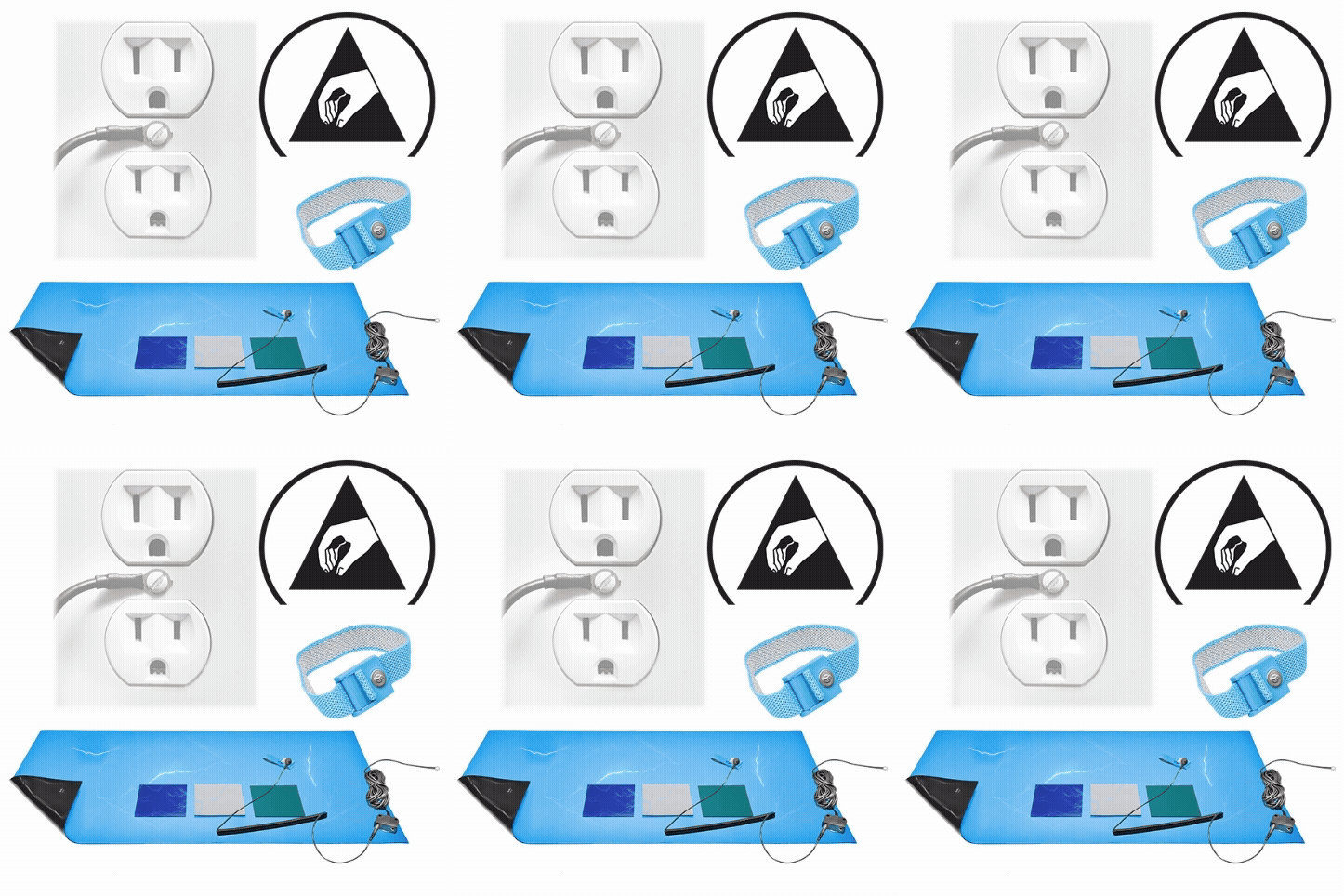
As shown in the picture, most ESD mats used for these purposes are static dissipative on top (blue) and conductive on the bottom (black). The conductive bottom layer ensures charge flows to ground if the mat contacts a grounded surface.
ESD Ground Points
ESD Ground Points come in several different types. The grounding cable connects the anti static mat used as a work surface to the grounded electrical outlet.
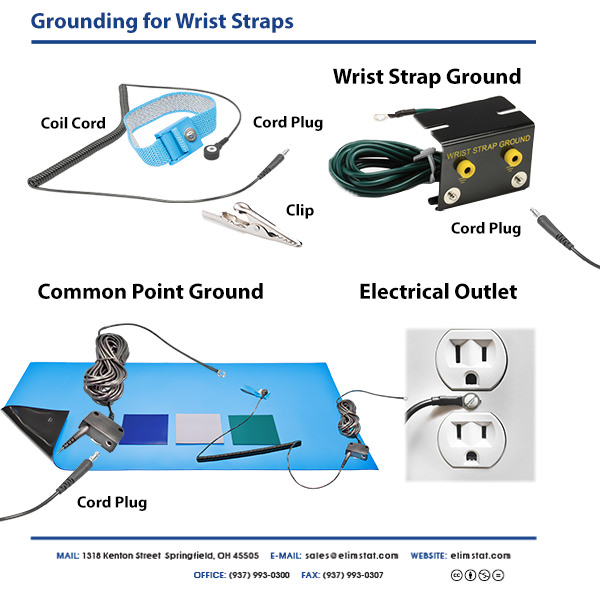
There are grounding cables for mats, wrist straps, and common point grounds for both.
Do not use the alligator clip to attach the wrist strap to the anti static mat. This will not work. In fact, this will increase the total system resistance to ground because the wrist strap and mat ground cords incorporate built-in resistors.
Unless necessary, it’s recommended not to use the alligator clip. While it seems convenient, it is best used only when you are sure of the pathway to the ground.
ESD Wrist Straps and Mats
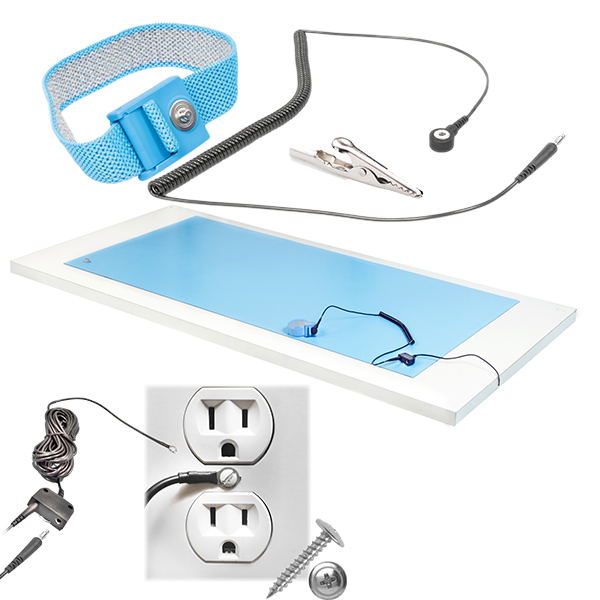
A wrist strap keeps the wearer at the same electrical potential as the mat and the common point ground by providing a controlled path to ground. Instead of allowing static charge to build up on the body, the strap continuously equalizes charge as you move, reducing the chance of a sudden discharge into sensitive electronics.
Many wrist straps use conductive fibers (often silver- or carbon-based) woven into a fabric band to ensure reliable contact with the skin. When connected through the cord, this contact allows any accumulated charge to dissipate gradually rather than releasing all at once.
When both the wrist strap and the work surface are connected to a common ground point, the person and the mat share the same reference. That minimizes voltage differences between you, the work surface, and the device—helping prevent electrostatic discharge during handling.
In ANSI/ESD S20.20 Section 8.2 (Personnel Grounding), wrist straps are recommended to be used at all times if personnel are seated at workstations. When standing, it recommends that personnel be grounded via a wrist strap and/or a footwear/flooring system. If a wrist strap is worn with a static control garment for grounding, it should meet the requirements of a groundable static control garment system.
Questions this guide answers
What does a mat do that a wrist strap does not?
Mats bond work surfaces. Wrist straps bond people. Smocks reduce charge on clothing, and ionizers neutralize charge on insulators that cannot be grounded.
What counts as a static source in the work area?
Treat any ungrounded object as a potential ESD source. The article includes carpets, plastics, unfinished wood, and isolated conductors. Clothing can couple charge into electronics before you touch them.
Which resistance range does S4.1 want on a work surface?
Static dissipative: above 1 × 10^6 ohms and not above 1 × 10^9 ohms. Below 1 × 10^6 ohms is conductive. Above 1 × 10^9 ohms is insulative.
When is a wrist strap required?
S20.20 section 8.2 recommends a wrist strap at all times if personnel are seated. Standing personnel may be grounded with a wrist strap and/or a footwear and flooring system.